Monday, February 25, 2013

The Science is in Your Soil

11:24 AM
One key component that needs to be addressed in planning your garden is the soil.  The right kind of soil (and it's acidity level) can make all of the difference between plants that grow and the ones that die.  I want to take the time now to address the issue of the acidity levels and what many of us are plague with in the Carolinas and that is clay.
 
I saw this article today on About.com.  It touches on some of the bases that we need to begin to address if we're going to have a prosperous garden.  Take a look:

Taken from "Organic Gardening" on About.com
 
Clay soil is prevalent many parts of the United States, and it can be a real pain if you happen to decide that you want to plant a flower or vegetable garden. While many trees and shrubs grow well in clay, the roots of the majority of annuals, perennials, and vegetables just aren't strong enough to make their way through. And if spring flower bulbs are your dream, forget it. Bulbs tend to rot over the winter in clay soils. With a bit of background about clay, and a strategy for improving your soil structure, you'll be able to grow flowers and vegetables to your heart's content.to grow flowers and vegetables to your heart's content.

What is Clay Soil?

Clay soil is defined as soil that is composed of mostly clay particles. Soil that consists of over 50% clay particles is referred to as “heavy clay.” To determine whether you have clay soil or not, you can do a simple soil test. Most likely, you probably already know if you have clay soil. If your soil sticks to shoes and garden tools like glue, forms big clods that aren't easy to separate, and crusts over and cracks in dry weather, you have clay.
Positives of Clay Soil
Even clay soil has some good qualities. Clay, because of its density, retains moisture well. It also tends to be more nutrient-rich than other soil types. The reason for this is that the particles that make up clay soil are negatively charged. They attract and pick up positively charged particles, such as calcium, potassium, and magnesium.
Negatives of Clay Soil
In addition to the drawbacks mentioned above, clay also has the following negative qualities:
  • Slow draining
  • Slow to warm in the spring
  • Compacts easily, making it difficult for plant roots to grow
  • Tendency to heave in winter
  • Tendency to be alkaline

Improving Clay Soil

Improving your clay soil will take a bit of work, but the good news is that the work you do will instantly improve the structure of your soil and make it easier to work with. Most of the work is done up front, with some annual chores to continue improving your soil.
It is best to improve an entire planting area all at once. I often see advice about just improving individual planting holes as you go along, but I don't recommend this practice. When you dig a planting hole in clay soil, then plop in a plant and nicely amend only the soil you use to backfill, your plant will be happy for a little while. But what you've essentially done is make the planting-hole equivalent of a flower pot. Eventually, the plant will start sending out roots, but when they reach the limits of the nicely amended soil you backfilled with, they will have a hard time expanding into the hard clay around them, and will start circling around in the planting hole instead. You'll end up with a perfectly root bound plant, and it won't grow as large or as healthy as it should.
Decide how much area you want for your new garden. If you are improving an existing bed, you'll just have to dig out any plants you want to keep, and then you can get started. If you are preparing a brand new bed, there are a few more steps to consider.
To improve your soil, you'll need to add six to eight inches of organic matter to the entire bed. You can add any organic matter you can get your hands on. Grass clippings (as long as they haven't been treated with chemicals), shredded leaves, rotted manure, and compost are all perfect choices. Spread your organic matter on top of the soil. Here's where the manual labor comes in. The organic matter needs to be mixed into the top six to twelve inches of soil. Digging it in and mixing it with a shovel is a great way to do this, as it moves a lot of earth without pulverizing the soil particles the way tilling can. However, if digging is just too hard on your back, using a tiller is a fine method.
When you're finished, your garden bed will be several inches higher than it was originally. It will settle some over the course of a season, but the soil structure will keep improving as microorganisms in the soil work to break down all of the organic matter you've added. The bed can be planted immediately, however. You'll be adding more organic matter on the top of the bed once or twice a year. This will continue the process of improving the soil's structure and offset any settling that happens.

Testing for Fertility and Adding Fertilizers

After a season or so, it's a good idea to collect a soil sample and have it tested to see if you have any nutrient deficiencies or pH issues. The report you get back will offer suggestions for how to improve the garden further. Add any organic fertilizers or soil amendments outlined in your report, and your bed will be perfect for growing healthy plants.
It's a bit of work. But you can be secure in the knowledge that you won't have to waste time struggling with clay soil again.
 
Happy Gardening!
~The Farmer's Assistant:)

Sunday, January 27, 2013

Getting the Garden Ready!

12:18 PM
It's that time again!  After a summer marked by erradict heat and changes in the weather the fall and early winter have been a quiet, quiet season in our garden.  It is now time to start pulling up anything and everything that's been left over from the fall, and plow the garden to prepare for spring & summer planting.
Today, Papa went out to the garden to find that there were still some herbs trying to make a come back in the midst of it all:)
Our corn also needed to be pulled up. 
(Now, usually, we will have a fall garden, and when we do, these areas are already plowed
over and cleared out but since we didn't there are some of the summer plants still remaining).
As well as many of the stakes:
These were the stakes that we used as supports for pepper plants and garden borders on the second half of the garden.
 Now one might think, "why not re-use the stakes from the previous season?"  If you look closing in the picture on the right, you will see were part of the stake began to rot.  And that can happen.  Now you can use metal stakes but they're going to be a little more pricey.  So stick to the wooden stakes.  If you need something for support for a plant (like peppers or tomatoes with cages) that are going to be growing tall, they're the way to go!
 

Monday, October 15, 2012

Apple Picking: A Fall Family Tradition

9:18 AM
 
It's that time of year again!  Family & friends, mommies and daddies, little ones, silver ones and everyone in between are experiencing the wonderful tradition of going apple picking:-)
 
We had the joy of going ourselves to the Windy Hill Apple Orchard in York, SC.  And it really was a treat!  According to some of the employees at this family run orchard, due to the weather, apples were ready much earlier than they normally would have been.  So while we were there we got to enjoy some of their fare and brought home our own bundle of apples:-) 
 
We hYope that you will enjoy this wonderful weather & that you find your way to your favorite place to go apple picking with your loved ones.
 
Did I mention that there's an Apple Festival happening this weekend?
 
Happy Pickin' !


Sunday, September 30, 2012

Green Tomato Cake

12:04 AM
This is about the time of year that I'm usually going out to pick whatever's not yet ripe of our tomatoes before the frost hits to make up some green tomato cake.  But unfortunately, the weather has been so wacky that there aren't really any green heirloom tomatoes out there.  So, I've been asked for this recipe time and time again.  And here I am to finally post it after a very loooonnng delay (my apologies:-(
 
Green Tomato Cake
As seen on Allrecipes.com
4 cups chopped green tomatoes
1 tablespoon salt
1/2 cup butter
2 cups white sugar
2 eggs
2 cups all-purpose flour
1 teaspoon ground cinnamon
1 teaspoon ground nutmeg
1 teaspoon baking soda
1/4 teaspoon salt
1/2 cup raisins
1/2 cup chopped walnuts

Directions

  1. Place chopped tomatoes in a bowl and sprinkle with 1 tablespoon salt. Let stand 10 minutes. Place in a colander, rinse with cold water and drain.
  2. Preheat oven to 350 degrees F (175 degrees C). Grease and flour a 9x13 inch baking pan.
  3. Cream butter and sugar. Add eggs and beat until creamy.
  4. Sift together flour, cinnamon, nutmeg, soda and 1/4 teaspoon salt. Add raisins and nuts to dry mixture; add dry ingredients to creamed mixture. Dough will be very stiff. Mix well.
  5. Add drained tomatoes and mix well. Pour into the prepared 9 x 13 inch pan.
  6. Bake for 40 to 45 minutes in the preheated oven, or until toothpick inserted into cake comes out clean.
Bon Appetit!
~Chemeeka

Tuesday, September 18, 2012

Sharing the Love

1:38 PM
Formerly the home of Bakie Me Sweet now at LoveFarmCake I blend my knowledge of gardening, cooking & baking, along with the expertise that I share with the moms of Charlotte as Cooking Coach and present to you one home, for moms.  You will laugh, cry & hopefully be wowed as I share easy to replicate tips & give you the tools that you need to share the love with the ones that you love.  Oh, and there'll be some Mommy Moments too...!

Check it out here.

Monday, September 17, 2012

Pretty Peppers

1:35 PM
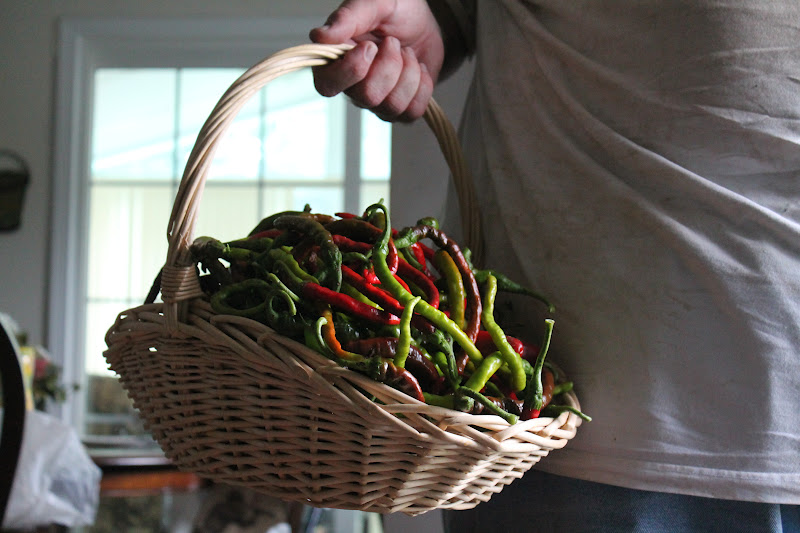
 Aren't these just beautiful?  Oh!  Who would have told me five years ago that I'd be sitting here taking pictures of peppers...I never would have believed it.  Here is batch #2 of our pretty peppers.
 I had to get this shot here (above) to let you know of all of the varieties that we are growing because it's hard to tell in the baskets.  You see the greens, the yellows, oranges and reds but you can't really point out what's there (with the exception of the little cayennes).  So here goes, when you're looking at this picture above, the top two red & green ones are: ancient sweets, then we've got three types of bells coming across the top.  You can tell those pretty well.  Then down beneath those (the skinny ones) are the long and short cayennes, then on your bottom left, you've got the hungarian (paprika) peppers and on the right are red jalapenos (green and red jalapenos are basically the same, just one's (the reds) are riper than the other (the green ones).


 Our tomatoes are pretty much done for the season, we've got a few heirloom and cherokee that are trying to make a comeback before the frost hits.  But other than that, we're pretty much all herbs and peppers, ridin' out the rest of the season!
 
Happy Farming!
 
The Farmer's Assistant :-)

Tuesday, September 11, 2012

Fresh Picked:Cayenne's and Bell Peppers

12:09 AM


This is our latest batch of cayenne and bell peppers and there's a lot more to be picked.  As you already know, just one plant puts out a LOT of fruit, be it whatever veggie (ie. tomatoes, herbs, peppers) you name it.  You don't have to have a lot of any one plant to bring in a hearty harvest. 
The right amount of soil, sunlight and water is really all that you need.  Even your average container garden with a little touch of tender, love and care can go a long way.  Sometimes with a large plant, you may have to use a stake to stablize the plant but beyond that, you're good to go!  Bell peppers, anyone?
 
The Farmer's Assistant